Sequential balanced sampling
Introduction
Balanced sampling plays a crucial role in applied statistics. In this vignette, we explain how to use the balseq function to select a balanced and spatially distributed sample. For a detailed explanation of the method, refer to doi:10.1002/env.2776.
Loading Data
We will use the belgianmunicipalities dataset from the sampling package, which does not contain spatial coordinates. Fortunately, a GEOjson file is available on ArcGIS Hub. We transform it into an sf object and compute the municipalities’ centroids to distribute the sample across space.
# to load data
library(sampling)
library(geojsonio)
library(ggplot2)
library(viridis)
library(rgeos)
library(sf)
library(rmapshaper)

data("belgianmunicipalities")

# load geojson directly from the url
belg  <- geojson_read("https://opendata.arcgis.com/datasets/9589d9e5e5904f1ea8d245b54f51b4fd_0.geojson",what = "sp")

# simplify the variable and transform it into a sf object
belg <- rmapshaper::ms_simplify(input = belg,keep = 0.01) %>%
  st_as_sf()

coord <- gCentroid(as(belg, "Spatial"), byid = TRUE)

# concatenated file
Belgium <- cbind(belg,belgianmunicipalities,coord)
head(Belgium)
#> Simple feature collection with 6 features and 26 fields
#> Geometry type: MULTIPOLYGON
#> Dimension: XY
#> Bounding box: xmin: 4.216306 ymin: 51.08066 xmax: 4.564865 ymax: 51.37764
#> Geodetic CRS: WGS 84
#> OBJECTID ADMUNAFR ADMUNADU ADMUNAGE Communes CODE_INS arrond Commune INS Province Arrondiss
#> 1 1 AARTSELAAR AARTSELAAR AARTSELAAR Aartselaar 11001 11 Aartselaar 11001 1 11
#> 2 2 ANVERS ANTWERPEN ANTWERPEN Antwerpen 11002 11 Anvers 11002 1 11
#> 3 3 BOECHOUT BOECHOUT BOECHOUT Boechout 11004 11 Boechout 11004 1 11
#> 4 4 BOOM BOOM BOOM Boom 11005 11 Boom 11005 1 11
#> 5 5 BORSBEEK BORSBEEK BORSBEEK Borsbeek 11007 11 Borsbeek 11007 1 11
#> 6 6 BRASSCHAAT BRASSCHAAT BRASSCHAAT Brasschaat 11008 11 Brasschaat 11008 1 11
#> Men04 Women04 Tot04 Men03 Women03 Tot03 Diffmen Diffwom DiffTOT TaxableIncome Totaltaxation averageincome
#> 1 6971 7169 14140 7010 7243 14253 -39 -74 -113 242104077 74976114 33809
#> 2 223677 233642 457319 221767 232405 454172 1910 1237 3147 5416418842 1423715652 22072
#> 3 6027 5927 11954 6005 5942 11947 22 -15 7 167616996 50739035 29453
#> 4 7640 8066 15706 7535 7952 15487 105 114 219 186075961 46636930 21907
#> 5 4948 5328 10276 4951 5322 10273 -3 6 3 143225590 40564374 26632
#> 6 18142 18916 37058 18217 18903 37120 -75 13 -62 533368826 153629397 30574
#> medianincome x y geometry
#> 1 23901 4.382005 51.13223 MULTIPOLYGON (((4.400451 51...
#> 2 17226 4.369578 51.26067 MULTIPOLYGON (((4.368136 51...
#> 3 21613 4.516463 51.16576 MULTIPOLYGON (((4.530071 51...
#> 4 17537 4.371434 51.09387 MULTIPOLYGON (((4.385267 51...
#> 5 20739 4.488162 51.19138 MULTIPOLYGON (((4.509002 51...
#> 6 21523 4.500281 51.30940 MULTIPOLYGON (((4.540815 51...Data visualization
We visualize Belgian municipalities with their average income using ggplot2.
p <- ggplot()+
  geom_sf(data = Belgium,aes(fill = averageincome),size = 0.1)+
  scale_fill_viridis_c(option = "G")
p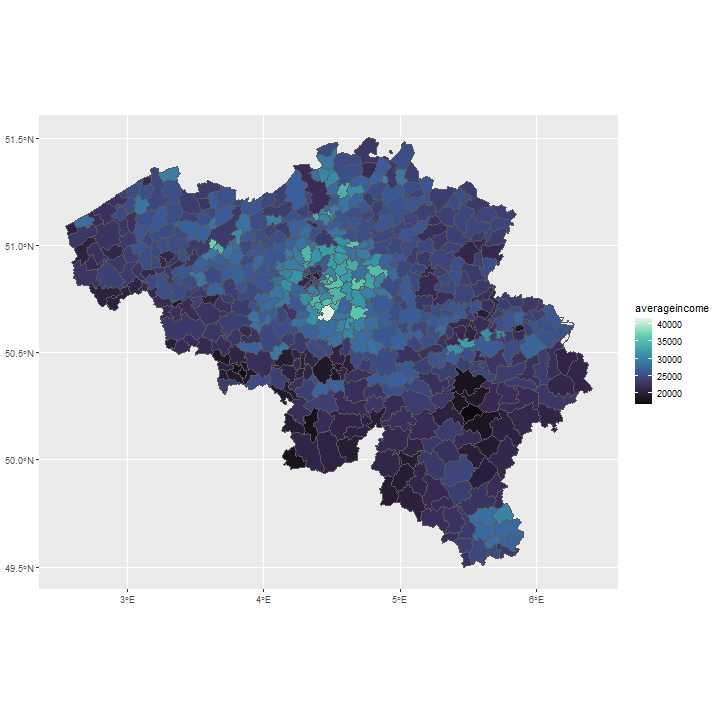
Inclusion probabilites
A good sample should maintain the population’s characteristics. By defining proportional inclusion probabilities, we ensure better representativity. We set up here the inclusion probabilities equal with sum equal to 50. i.e. the sample will contain 50 units.
N <- nrow(Belgium) # population total
n <- 50 # sample size

# variable of interest
y <- belgianmunicipalities$averageincome

# auxiliary variables
Xaux <- cbind(belgianmunicipalities$Tot04,
              belgianmunicipalities$Women04,
              belgianmunicipalities$TaxableIncome,
              belgianmunicipalities$Diffmen,
              belgianmunicipalities$Diffwom)


# inclusion probabilities
pik <- rep(n/N,N)

Xaux <- cbind(pik,Xaux) # add pik to fixed sample size
Xspread <- coord
Balanced sampling
We compare balanced sampling balseq with two other methods: samplecube and simple random sampling srswor. The percentage deviation from auxiliary totals helps evaluate the balance quality.
library(StratifiedSampling)

s <- balseq(pik,Xaux)
s_cube <- samplecube(Xaux,pik,comment = FALSE)
s_srs <- srswor(n,N)


TOT <- colSums(Xaux)
EST1 <- colSums(Xaux[s,]/pik[s])
EST2 <- colSums(Xaux[s_cube == 1,]/pik[s_cube == 1])
EST3 <- colSums(Xaux[s_srs == 1,]/pik[s_srs == 1])


100* (EST1 - TOT)/TOT
#> pik
#> 0.000000 4.908396 4.890552 6.873691 14.225213 6.440032100* (EST2 - TOT)/TOT#> pik
#> 0.000000 -4.068363 -4.153367 -8.105537 -19.212958 -14.508554100* (EST3 - TOT)/TOT#> pik
#> 0.00000 12.99101 12.52005 12.72183 -13.28123 -21.77427Spread sampling
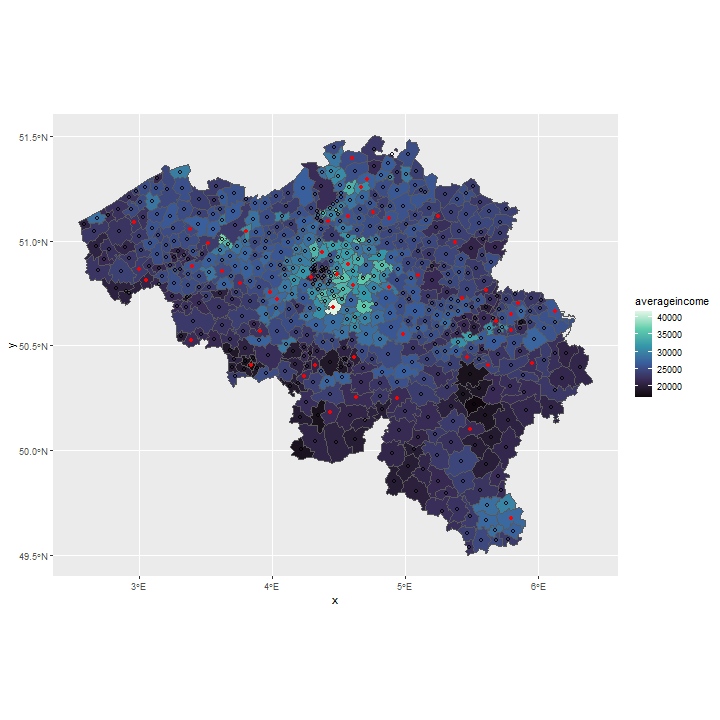
To incorporate spatial distribution, we use geographic coordinates as a matrix to the argument Xspread of the function. Here coord is an output of the function gCentroid which is by construction an S4 object. To get the data.frame that are encapsulated inside, we simply use the @coords operator.
s <-  balseq(pik,
             Xaux,
             Xspread = as.matrix(Xspread@coords))
p <- p +
  geom_point(data = Belgium,aes(x = x,y = y),shape = 1,alpha = 0.9)+
  geom_point(data = Belgium[s,],aes(x = x,y = y),colour = "red")+
  scale_fill_viridis_c(option = "G")
p